











TL;DR. A SWMS (Safe Work Method Statement) is a document required under every state’s WHS Regulation for high-risk construction work (HRCW). It identifies the work, the hazards, the controls, and who’s responsible — in plain English for workers doing the job. SWMS are not “paperwork exercises”; they’re a regulator-prosecuted requirement. Cert IV WHS (BSB41419) teaches you how to write, review, and implement SWMS properly — an essential skill for any WHS Officer role paying $75,000–$120,000+.
What is a SWMS?
A Safe Work Method Statement (SWMS) is a written document that describes:
- The specific high-risk construction work being done
- The hazards arising from that work
- The controls in place to manage those hazards
- How those controls will be implemented, monitored, and reviewed
SWMS are legally required under the WHS Regulation for high-risk construction work (HRCW) — a specific list of 18 activities defined in the model regulation, including working at heights, confined spaces, demolition, tilt-up construction, and work on or near live electricity.
The 18 high-risk construction work (HRCW) activities
SWMS are required for any work that involves:
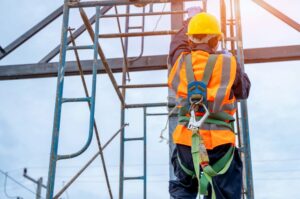
- Risk of falling more than 2m
- Work on telecommunications towers
- Demolition of load-bearing structures
- Disturbance of asbestos
- Structural alterations requiring temporary support
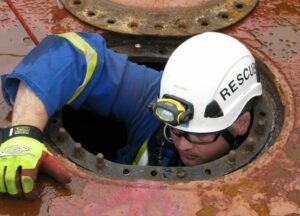
- Confined spaces
- Excavation more than 1.5m
- Tunnels and shafts
- Explosives
- Work near pressurised gas mains
- Work near chemical, fuel, or refrigerant lines
- Work near energised electrical installations / services
- Contaminated or flammable atmospheres
- Tilt-up or precast concrete work
- Work on or near roads or railways in use
- Work in areas at risk of artificial extremes of temperature
- Work in areas that may have contaminated atmospheres
- Diving work
Who writes a SWMS?
The PCBU conducting the HRCW must prepare the SWMS — typically this means the contractor or subbie actually doing the work. On multi-contractor sites, the principal contractor coordinates SWMS but does not write them for subbies. WHS Officers and HSE Advisors commonly review and approve SWMS on behalf of the principal contractor before high-risk work starts.
This SWMS review process is one of the most common daily tasks for a Site Safety Officer or HSE Advisor on Australian construction sites.
What a good SWMS looks like
- Work-specific, not generic. “Cutting roof sheeting at Level 4, Building B, 7–10am Thursday” — not “working at heights in general”.
- Plain English workers can read on site. Short sentences, active voice, no legal jargon.
- Hazard-first structure. Identify the hazard, then the control — in that order.
- Hierarchy of control applied. Elimination > substitution > engineering > administrative > PPE. PPE-only SWMS are a red flag.
- Named responsible person for each control. “The leading hand verifies harness anchors before work starts.”
- Signed off by workers. Every worker doing the HRCW must be consulted and have signed they understood the SWMS.
- Live on site during the work. Not in a filing cabinet.
- Reviewed when the work changes. New trade, new weather, new sequence = SWMS review.
What a bad SWMS looks like
- Generic copy-paste from another project with the previous project’s logo still on it
- 10-page document of legal preamble and no actual work method
- PPE listed as the primary control for every hazard
- No named responsible person
- Workers haven’t signed it (or signed it weeks before the work started)
- Nobody on site has a copy or remembers reviewing it
How to review a SWMS in 10 minutes
- Match it to the actual work. Does it describe what’s happening today, here, with these people?
- Check the hazards list. Missing any obvious one (weather, services, neighbours, traffic)?
- Check the hierarchy. Is PPE the primary control for anything that could be engineered out?
- Check the named responsible person. Is it a real person who’ll be on site?
- Check worker sign-offs. Did the crew actually sign, and on a sensible date?
- Walk the job. Does what you see match the SWMS?
SWMS in Cert IV WHS
Cert IV WHS (BSB41419) covers SWMS writing, review, and implementation as part of the hazard-control and high-risk work units. This is one of the most practical, directly-on-the-tools skills in the qualification — and one employers test for in interviews for WHS Officer roles.
Will AI write SWMS?
AI tools will help you draft a SWMS. They will not replace the WHS Officer who reviews, tailors, and approves it — because a SWMS is a legal document that must match the actual work on the actual site today, and must be signed off by a named human PCBU representative. See: AI-proof careers in Australia.
Learn to write and review SWMS the regulator way
Cert IV WHS (BSB41419) — online, RTO 45189, finish in as little as 3 months.
Frequently asked questions
Is a SWMS the same as a JSA?
No. A JSA (Job Safety Analysis) is a risk-assessment exercise. A SWMS is a legally required document for high-risk construction work under the WHS Regulation. You can use a JSA to inform a SWMS, but they’re not interchangeable.
Who approves a SWMS on a multi-contractor site?
The subbie PCBU writes their own SWMS. The principal contractor (and their WHS Officer / Site Safety Officer) reviews and approves it before high-risk work starts.
How long is a SWMS valid for?
A SWMS is valid as long as the described work is being done and conditions haven’t changed. Any change in work scope, crew, weather, or sequence requires a SWMS review.
Does Cert IV WHS teach SWMS?
Yes. Cert IV WHS (BSB41419) covers SWMS writing, review, and implementation. Motivated students finish the whole qualification online in as little as 3 months.
Explore further
- Cert IV WHS — main course page
- How to Become a WHS Officer in Australia
- WHS Officer — Day in the Life