


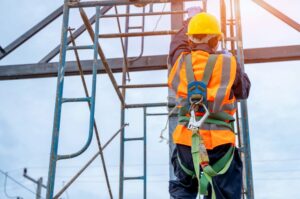






A working at heights “ticket” is the nationally recognised unit RIIWHS204E – Work Safely at Heights. It’s a hybrid course (about half a day of theory online, then a half-day practical at Lawnton) with a practical assessment that proves you’re trained to work safely at height under Queensland’s Work Health and Safety Regulation 2011 and the fall-protection standard AS/NZS 1891. On completion you receive a nationally recognised Statement of Attainment — it’s a competency, not a 5-year licence.
Cost at FMS Training: $310 per person for the course (about half a day of theory online, then a half-day practical at Lawnton), or $160 for the refresher if you already hold RIIWHS204E or the equivalent earlier unit RIIWHS204D. Book on the working at heights course page.
Key facts at a glance
- Unit: RIIWHS204E – Work Safely at Heights (nationally recognised)
- Duration: hybrid: about half a day of theory online, then a half-day practical face to face at Lawnton, with a practical assessment
- Outcome: Statement of Attainment (a competency, not a licence)
- Prerequisites: none — though you must be physically able to do the practical component
- Price (FMS): $310 course, $160 refresher (for holders of RIIWHS204E or RIIWHS204D)
- Refresher: no fixed government interval; your employer or site sets the rule
- Where (FMS): theory online, practical in person at Lawnton, north Brisbane, or at your site for groups
Do you legally need working at heights training in Queensland?
Under the WorkSafe Queensland Work Health and Safety Regulation 2011, a person conducting a business or undertaking must manage the risk of a fall, and workers who perform tasks at height must be trained and competent in height-safety procedures. RIIWHS204E is the standard, nationally recognised way employers meet that obligation across construction, mining, resources, trades, telecommunications and facilities work.
Working at heights ticket — the essentials
| Detail | What to know |
|---|---|
| Unit code | RIIWHS204E – Work Safely at Heights |
| Duration | Hybrid: half-day online theory, then half-day practical face to face at Lawnton |
| Outcome | Nationally recognised Statement of Attainment |
| Governing rules | WHS Regulation 2011 (Qld); AS/NZS 1891 fall-arrest systems |
| Prerequisites | None; must be fit for the practical assessment |
| Refresher | Recommended every ~2 years |
| Where (FMS) | In person at Lawnton, north Brisbane |
What’s covered in the course?
The course blends theory and hands-on practical work. Core topics include:
- Legislation and compliance — your duties under the WHS Regulation 2011 and AS/NZS 1891.
- Hazard identification and risk assessment for tasks performed at height.
- The hierarchy of control — eliminating the need to work at height where possible, then fall prevention, fall restraint, and finally fall arrest as a last resort.
- The physics of a fall — fall distance, free-fall and total fall clearance, and why they matter.
- Selecting, fitting and inspecting equipment — harnesses, lanyards, connectors and anchor points.
- Safe work methods for ladders, scaffolds, elevated platforms and roof work, plus emergency and rescue awareness.
The hierarchy of control for working at heights
A key idea you’ll take away is that fall prevention always beats fall arrest. The safest approach is to eliminate the need to work at height — for example, doing the work from the ground or a solid construction. Where that isn’t possible, you move down the hierarchy: passive fall prevention (such as guard rails), then work positioning and fall restraint, and only as a last resort, a fall-arrest system that stops a fall in progress. Understanding this order is what separates a compliant, safe site from a dangerous one.
How long is a working at heights ticket valid?
There’s no fixed legal expiry like a high-risk work licence, but many employers and sites ask for a refresher about every two years so your competency stays current with standards and equipment. Many employers and principal contractors require a refresher on that cadence before they’ll let you on site, so it’s worth keeping yours up to date.
Who should do this course?
Anyone whose work takes them off the ground: construction and trades workers, roofers, electricians and telco technicians, warehouse and logistics staff using mezzanines or racking, facilities and maintenance crews, and supervisors responsible for height-safety on site. There are no formal prerequisites, so it suits both new workers and experienced hands who need a current ticket.
What to bring on the day
Bring your USI (free to create online), photo identification, enclosed footwear and weather-appropriate clothing you can move in. FMS supplies the height-safety equipment for the practical assessment and walks you through fitting and inspecting it correctly.
Why train with FMS Training?
FMS Training delivers RIIWHS204E in person at our Lawnton facility in north Brisbane, with hands-on practical assessment and a nationally recognised Statement of Attainment. We’re a Registered Training Organisation rated a 4.9-star Google rating. Many clients combine it with our confined spaces course to ticket their team in one visit. See the Working at Heights course, or ask us about on-site group training.
Frequently asked questions
Is working at heights a “licence” or a “ticket”?
It’s a nationally recognised competency (a Statement of Attainment for RIIWHS204E), commonly called a “ticket”. It is not a high-risk work licence.
How long does the course take?
Hybrid: about half a day of theory online, then a half-day practical session at Lawnton, including the practical assessment.
Does a working at heights ticket expire?
There’s no fixed legal expiry, but many employers and sites ask for a refresher about every two years. If you already hold RIIWHS204E or the equivalent earlier unit RIIWHS204D, the FMS Training refresher is $160.
Are there any prerequisites?
No formal prerequisites. You should be physically able to complete the practical assessment using height-safety equipment.
Is RIIWHS204E recognised Australia-wide?
Yes — it’s nationally recognised training and is accepted across Australia.
Can I combine it with confined spaces training?
Yes — many workers complete both together. Ask FMS about scheduling working at heights and confined spaces in one visit.
Do you offer on-site training for teams?
Yes. We can deliver group training for employers — contact us to arrange a date and location.